


When you first start planning a yearbook, looking at an entire book can feel like a lot.
There are portraits, sports, clubs, academics, student life, special events, and plenty of other pages to fit into a limited amount of space.
That’s where a yearbook ladder comes in.
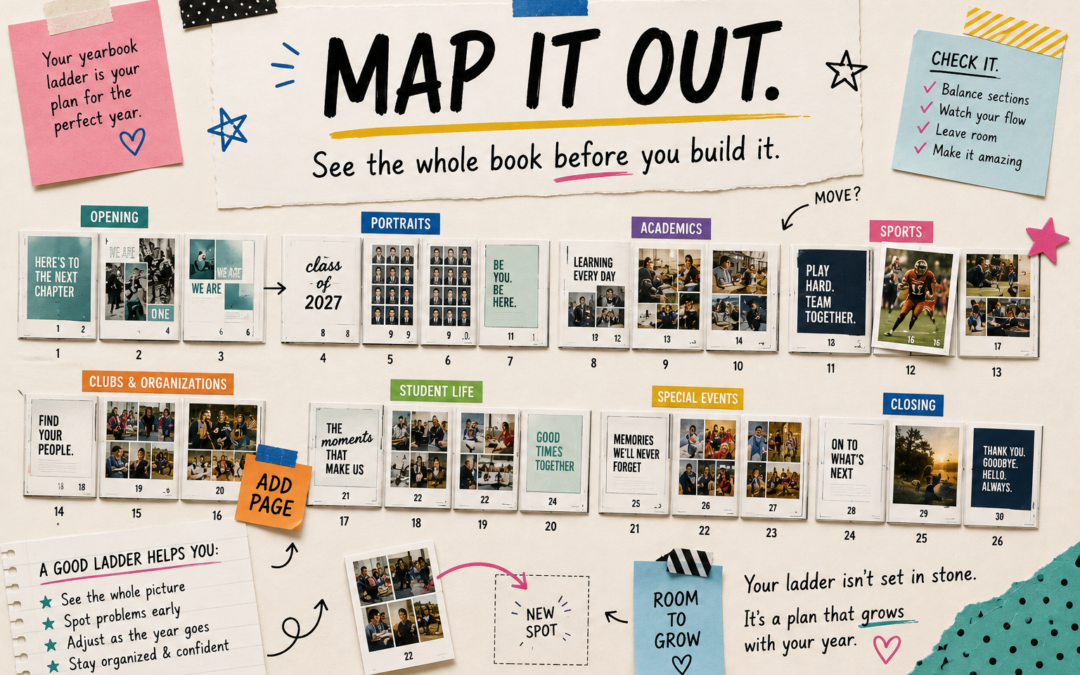
A yearbook ladder is simply a visual map of your entire book. It shows which content is planned for each page or spread, giving you a bird’s-eye view before everything is designed.
But a good ladder does much more than tell you what belongs on page 24.
It can help you organize the book, catch problems early, and adjust your plan as the school year unfolds.
Here are three reasons it’s one of the most useful yearbook planning tools you can have.
1. See the Whole Yearbook Before You Build It
When you’re working on individual pages, it’s easy to focus only on what’s directly in front of you.
A ladder lets you zoom out.
You can quickly see where your major sections fall, how many pages you’ve given each one, and how the book flows from beginning to end.
For example, you might map out space for:
- Opening pages
- Student portraits
- Academics
- Sports
- Clubs and organizations
- Student life
- Special events
- Closing pages
Once everything is visible in one place, the yearbook starts feeling less like dozens of individual assignments and more like one organized project.
You don’t have to design anything yet.
You’re simply giving every part of the book a place to live.
2. Catch Problems While They’re Still Easy to Fix
One of the best things about creating a ladder early is that it can reveal problems before they become actual problems.
Maybe you gave sports more pages than you realized.
Perhaps you forgot to leave enough room for a large graduating class.
A new club was added after your original plan.
Or you discover that one section feels crowded while another has more space than it needs.
Moving a few boxes around on a ladder is much easier than redesigning completed pages later.
It’s also a great way to check the balance of your coverage.
Take a look at the entire ladder and ask:
Does this feel like an accurate picture of our school?
If something important seems missing or another area feels oversized, you’ll know where to make adjustments.
3. Remember: The Ladder Can Change
Here’s something especially important for new yearbook advisors:
Your first ladder does not have to be your final ladder.
The school year will change.
Events may be added or canceled. A team might have an incredible season. A new program could launch. An activity you expected to need two pages might only need one.
That’s normal.
Think of your ladder as a working blueprint rather than a set of permanent rules.
Update it as the year progresses.
If something becomes more important, give it additional space. If something doesn’t happen as expected, use that space somewhere else.
Your ladder should help you stay organized without preventing you from adapting to the year you’re actually documenting.
Final Thought
A yearbook ladder may look like a simple collection of page numbers and boxes, but it’s really a picture of your entire book before the book exists.
It helps you see where you’re going, notice what might be missing, and make smarter decisions before pages start piling up.
Create your plan early, revisit it throughout the year, and don’t be afraid to move things around.
After all, the school year won’t follow a perfect plan.
Your yearbook doesn’t have to either.
Plan Your Yearbook with Confidence
A strong plan makes creating a yearbook much easier, and YearbookLife is here to help from the first page to the last. With easy-to-use yearbook software, flexible creation options, expert support, and high-quality printing, you’ll have the tools and guidance you need throughout the entire process.
Ready to start planning your school’s yearbook? Request your free, no-obligation quote today at YearbookLife.com.
Click HERE
