


Think about the last time you flipped through a yearbook.
Some pages probably earned a quick glance before you moved on. Others made you stop, look closer, read a caption, find a familiar face, or notice something you hadn’t seen before.
What makes the difference?
A great yearbook page doesn’t just hold photos and information. It gives readers a reason to explore.
As you begin designing pages for the new school year, here are three simple ways to create pages students won’t just flip past.
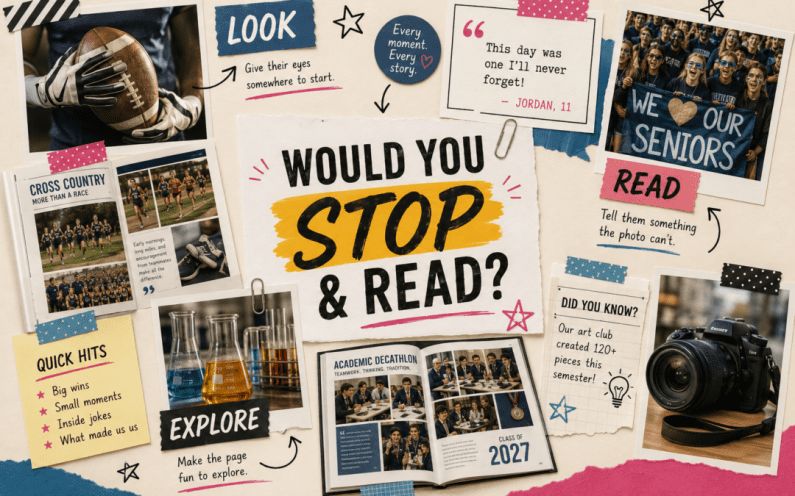
1. Give Their Eyes Somewhere to Start
When everything on a page is competing for attention, nothing really stands out.
Instead, give each spread a clear starting point.
That might be one great photo that’s larger than the others, an interesting headline, or a design element that naturally catches the reader’s eye.
From there, the rest of the page can support it.
Think of it like giving readers a path through the page rather than asking them to figure out where to look first.
You don’t need to fill every inch of available space, either. A little breathing room can make photos and other important elements stand out even more.
2. Tell Readers Something the Photo Can’t
A great photo can capture a moment.
Great writing tells us what was happening around it.
Instead of using a caption to simply describe what readers can already see, add something they wouldn’t know from looking at the picture.
What was the student thinking?
What happened five minutes before?
Why was everyone laughing?
Was this someone’s first time participating?
You can also mix traditional captions with:
- Student quotes
- Quick facts
- Fun statistics
- Short interviews
- Poll results
- Interesting details
These small pieces of information give students a reason to do more than look at the pictures.
They give them something to discover.
3. Make the Page Fun to Explore
Students don’t always read a yearbook from the top left corner to the bottom right.
They explore it.
They scan headlines.
They look for familiar faces.
They notice quotes.
They jump between photos.
Design your pages with that behavior in mind.
Instead of one large block of information, consider breaking content into smaller pieces. A short story, a student quote, a quick question-and-answer feature, and several well-chosen photos can work together to tell a much richer story.
Variety keeps the reader moving around the page and discovering something new along the way.
The goal isn’t to add more.
It’s to make what’s already there more interesting.
Final Thought
When you’re designing a yearbook page, there’s one simple question worth asking:
Would I stop here?
If the page has a clear focal point, interesting information, and a few things to discover, chances are your students will too.
A beautiful page might catch someone’s eye.
But a page that gives them something worth exploring is the one they’ll actually remember.
Create Pages Students Will Want to Explore
From the first layout to the final page, YearbookLife makes it easier to bring your yearbook ideas together. With flexible creation options, easy-to-use software, expert support, and high-quality printing, you’ll have the tools you need to create a book that looks great and is fun to read.
Ready to start creating your school’s yearbook? Request your free, no-obligation quote today at YearbookLife.com.
Click HERE
