


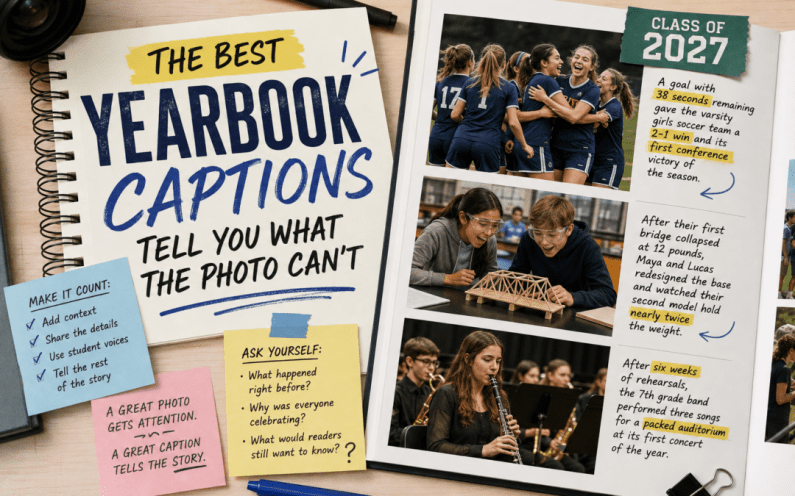
A great yearbook photo can capture the expression, the action, and the energy of a moment. But even the strongest photo usually leaves a few questions unanswered.
What happened right before it was taken? Why was everyone celebrating? Was this a first attempt, a final performance, or the moment that changed the outcome of a game?
That is where the caption comes in.
The best yearbook captions do more than identify what is happening in a photo. They add the information, personality, and context readers cannot get by looking at the image alone.
Before finalizing a caption, ask one simple question:
What would a reader still want to know after seeing this photo?
1. Do Not Describe What Readers Can Already See
One of the easiest caption mistakes is simply repeating what the photo already shows.
Weak Caption
Students perform during the fall concert.
The reader can already see students performing. The caption does not add anything new.
Better Caption
After six weeks of rehearsals, the seventh-grade band performed three songs for a packed auditorium at its first concert of the year.
Now the reader knows how long the students prepared, which group is performing, how many songs they played, and why the concert mattered.
Here is another example:
Weak Caption
The soccer team celebrates after the game.
Better Caption
A goal with 38 seconds remaining gave the varsity girls soccer team a 2-1 win and its first conference victory of the season.
The second caption explains the celebration instead of simply pointing it out.
A useful caption does not say, “Here is what you are looking at.” It says, “Here is what you would not know just by looking.”
2. Add the Detail Behind the Moment
Strong captions often depend on one specific detail.
That detail might be:
- The final score
- How long students prepared
- Whether it was someone’s first attempt
- What caused the reaction in the photo
- What happened next
- A funny circumstance
- The result of the activity
- An unexpected challenge
You do not need to include every fact you collected. Choose the detail that makes the moment more interesting or easier to understand.
Weak Caption
Students test their bridge during science class.
Better Caption
After their first bridge collapsed at 12 pounds, seventh graders Maya Chen and Lucas Reed redesigned the base and watched their second model hold nearly twice the weight.
The stronger caption gives the photo a beginning, a challenge, and a result. It turns a classroom activity into a small story.
When gathering information, look beyond the basic questions of who, what, when, and where. Ask what made this particular moment worth including.
Was the performance sold out? Did the team come from behind? Was this the club’s first meeting? Did the experiment work on the first try? Did something happen that made everyone laugh?
Those are often the details readers will remember.
3. Let Students Help Tell the Story
Sometimes the best information comes directly from the people in the photo.
A short student quote can add humor, emotion, or perspective without making the caption too long. It also helps the page sound like the students who experienced the year rather than an adult summarizing it for them.
Instead of asking a broad question such as, “Did you have fun?” try asking:
- What were you thinking right then?
- What happened that nobody watching would know?
- What was your favorite part?
- What surprised you?
- What happened immediately after the photo was taken?
Specific questions usually lead to better answers.
Weak Caption
Eighth grader Emma Ruiz smiles after finishing the cross-country race.
Better Caption
“I thought I had started too fast, but when I heard my teammates near the finish line, I knew I could keep going,” said eighth grader Emma Ruiz after setting a personal best in the final home meet.
The quote gives the reader access to something the photo cannot show: what Emma was thinking during the race.
Quotes do not need to be long. One sentence is often enough. Choose the part that adds information, reveals personality, or helps the reader understand why the moment mattered.
A simple formula can help:
Who + what happened + one detail the photo cannot show + an optional quote
The result is a caption that feels complete without becoming a full paragraph.
Final Thought
A photo may be what makes someone stop on a page, but the caption is what helps them understand the full moment.
Strong yearbook captions do not have to be long or complicated. They simply need to contribute something the photo cannot provide on its own.
Before approving a caption, cover the words and look at the photo. Then ask what information is still missing. That answer is usually where the better caption begins.
Give Every Page More to Say
YearbookLife makes it easier to bring photos, stories, captions, and layouts together in one complete yearbook. With flexible creation options, easy-to-use software, expert support, and high-quality printing, your team has the tools it needs from the first page to the finished book.
Ready to begin your school’s yearbook? Request your free, no-obligation quote today at YearbookLife.com.
Click HERE
