
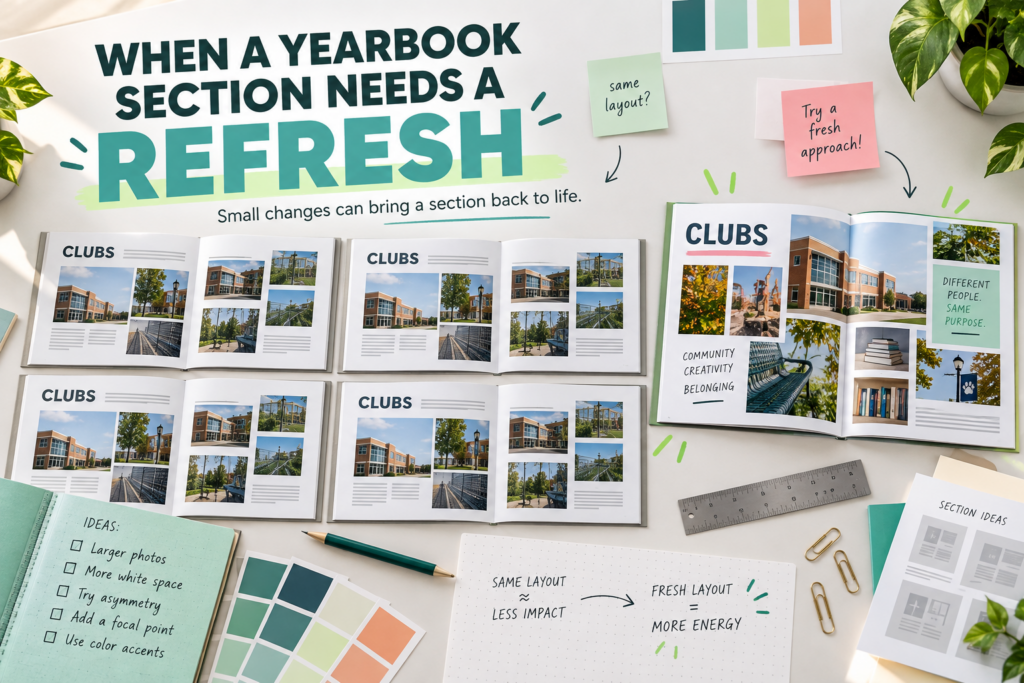
Sometimes every individual page looks fine, but the section as a whole starts feeling repetitive.
The same photo arrangement shows up again.
The headlines sit in the same place.
The same type of graphic appears on every spread.
Nothing is necessarily wrong, but the section starts losing energy.
That is usually a sign that it needs a small refresh—not a complete redesign.
1. Look at Several Pages Together
It is hard to spot repetition when you are only looking at one spread at a time.
Instead, step back and look at several pages from the same section together.
Ask:
- Are the layouts too similar?
- Are the same photo sizes repeating?
- Do the headlines always appear in the same place?
- Are the pages using the same balance of photos and text?
- Does every spread have the same visual energy?
Consistency is important.
But if every page follows the exact same formula, the section can start to feel predictable.
Seeing multiple spreads together makes those patterns much easier to notice.
2. Change One Thing at a Time
A refresh does not mean abandoning your design system.
You can keep the same fonts, colors, folios, and overall theme while changing the way the content is presented.
Try changing:
- The size of the main photo
- The number of photos
- The headline placement
- The amount of white space
- The type of supporting content
- The balance between photos and text
Even one change can make the next spread feel noticeably different.
The goal is variety within the same visual family.
3. Match the Layout to the Story
Sometimes sections become repetitive because the same layout is being used no matter what the story actually needs.
A championship game may need a high-energy spread.
A quiet classroom story may work better with fewer photos and more breathing room.
A club feature might benefit from quotes or quick facts.
Let the content influence the layout.
When the page design responds to the story, the section naturally becomes more varied.
That keeps the book interesting without making it feel disconnected.
Final Thought
A yearbook section does not need a completely different design on every page.
But it should not feel like the same spread repeated over and over either.
Look at several pages together.
Notice where the patterns are becoming too predictable.
Then change one or two elements while keeping the overall design system intact.
A small refresh can give an entire section new energy.
Keep Every Section Moving
YearbookLife gives schools flexible creation options, easy-to-use software, expert support, and high-quality printing to help yearbook teams create sections that feel connected without becoming repetitive.
Ready to start creating your school’s yearbook? Request your free, no-obligation quote today at YearbookLife.com.
Click HERE
